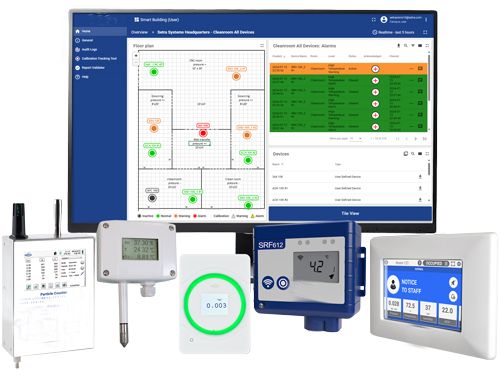
Cleanroom environmental monitoring combines measurements of room conditions with particle testing and microbiological sampling. Together, these activities help facilities assess the environment used for sterile compounding and aseptic processing.
A clean room monitoring system can track conditions such as differential pressure, temperature, and relative humidity. These readings support a wider monitoring program; they do not establish that a room or product is sterile.
What Does Clean Room Environmental Monitoring Include?
- Room conditions: Pressure, temperature, and humidity readings help staff identify changes in the operating environment.
- Non-viable airborne particles: Particle counters measure particle concentrations by size. They do not identify whether particles contain living microorganisms.
- Microbiological air sampling: Defined sampling methods assess recoverable airborne microorganisms.
- Surface sampling: Sampling selected surfaces provides information about microbial contamination at those locations.
Environmental testing in a cleanroom should follow a documented plan. Room sensors, particle counters, and microbial samples answer different questions and should be reviewed together.
Cleanroom Environmental Testing vs. Continuous Monitoring
Cleanroom environmental testing evaluates defined conditions at specified times. Continuous monitoring records selected parameters over time and can alert staff to changes between scheduled assessments.
A facility may need both. A room sensor does not replace microbial sampling, and a single satisfactory test does not describe every condition during later operations.
If you need laboratory analysis, sampling services, or cleanroom qualification, define that scope separately from a monitoring-equipment quotation.
Core Parameters for Cleanroom Environmental Monitoring
Differential Pressure
Differential pressure monitoring measures the pressure difference between spaces. The required direction depends on the application: product protection and hazardous-material containment can require different pressure arrangements.
Interpret readings against the approved room design and operating procedures. Identify the two spaces connected to each pressure measurement, rather than recording a pressure value without its reference location.
Temperature and Relative Humidity
Temperature and humidity records help staff review operating conditions and identify departures from established limits. Define the acceptable ranges, sensor locations, and response procedures for the intended process.
Airborne Particle Levels
Particle measurements support assessment of airborne cleanliness. Particle counts are not a substitute for microbiological air or surface sampling, and a particle result alone cannot confirm sterility.
Build a Practical Environmental Monitoring Plan
Make the program clear enough for staff to follow during normal work and when conditions change. Document:
- The rooms, activities, and environmental conditions covered.
- Sensor and sampling locations, with reasons for their selection.
- Measurement methods and monitoring or sampling schedules.
- Operating limits, alert settings, and responsibilities for responding.
- Calibration, maintenance, and checks of monitoring equipment.
- Record review, retention, and investigation procedures.
Define how results are reviewed over time. Repeated alerts or changing trends may need attention even when an individual result does not trigger an action limit.
Responding to Alarms and Reviewing Trends
An alarm needs a response procedure, not just a notification. Specify who receives the alert, who reviews it, how unresolved alarms are escalated, and where the outcome is recorded.
For example, if a pressure alarm coincides with a door opening, review the duration, recovery, and surrounding readings under your procedure. Do not assume every alarm is a sensor fault or dismiss repeated events. The responsible team must assess any impact on ongoing work.
Review historical data for recurring excursions, gaps, and changes following maintenance. Confirm that sensors, alarm delivery, and data recording function as intended after installation and relevant system changes.
USP 797 Environmental Monitoring and Cleanroom Requirements
USP <797> addresses sterile compounding, including facilities, personnel practices, and environmental monitoring. Facilities handling hazardous drugs should also review the applicable provisions of USP <800>.
ISO 14644-1 addresses classification by airborne particle concentration. ISO 14644-2 addresses a monitoring plan related to that performance. These particle-cleanliness activities do not replace microbiological monitoring.
Use the current applicable standards to establish the requirements for your operation. Cleanroom classification, routine monitoring, and microbiological sampling serve related but distinct purposes. Purchasing monitoring equipment does not by itself establish facility compliance.
Choosing a Clean Room Monitoring System
Start with the measurements you need and the people who must respond. When comparing systems, ask:
- Which parameters and how many rooms can the proposed configuration monitor?
- How are alarms delivered, acknowledged, and escalated?
- Can staff review historical readings and export useful reports?
- What happens during a power or network interruption?
- What access controls, record protection, and validation documentation are available?
Confirm installation, calibration, training, support, and any ongoing costs in the quotation. Ask for the documentation needed to assess electronic records and validation for your intended use, rather than relying on a general compliance label.
What Determines System Cost?
Request a quotation based on the number of monitoring points, sensor types, connectivity, reporting needs, and installation scope.
Also confirm data retention, calibration, support, and any recurring charges. Comparing the same scope makes different proposals easier to assess.
The AE Clean Room Monitor
Aseptic Enclosures describes the AE Clean Room Monitor (CRM) as a system for monitoring differential pressure, temperature, humidity, particulate levels, airflow velocity, and door status.
The product page lists a browser-based dashboard, historical data, reports, configurable alarm thresholds, and email or SMS notifications.
Ask AE to confirm the sensors, notification options, data retention, and documentation included in your proposed configuration.
Frequently Asked Questions
What Does Environmental Testing in a Cleanroom Include?
Depending on the facility and its applicable requirements, cleanroom environmental testing may include airborne particle measurements, microbiological air sampling, surface sampling, and other defined assessments. The testing methods, locations, frequency, and acceptance criteria should be established in a documented monitoring plan.
Does Continuous Room Monitoring Replace Microbial Sampling?
No. Pressure, temperature, and humidity sensors measure physical conditions. Microbiological air and surface sampling provide different information about contamination.
How Often Should a Cleanroom Be Monitored?
The schedule depends on the parameter, activity, and applicable requirements. Define continuous measurements and periodic sampling separately in the monitoring plan.
Does a Monitoring System Control Pressure or Humidity?
Monitoring measures and records conditions. Control requires equipment and a control arrangement designed for that purpose. Confirm whether a proposed system only monitors conditions or also interfaces with control equipment.
Can AE Provide Email or Text Alerts?
AE’s product page lists email and SMS notifications. Confirm availability, setup, and escalation arrangements for the quoted system.
Discuss Your Cleanroom Monitoring Requirements
Prepare a short room-by-room list before requesting a quote:
- Space and activity: Room name, intended work, and relevant facility requirements.
- Monitoring points: Required temperature, humidity, pressure, or particle measurements. For pressure, identify each room pair.
- Notifications: Primary and backup contacts, preferred email or SMS alerts, and after-hours coverage.
- Records: Reporting format, access permissions, and retention needs.
- Site details: Floor plan, existing sensors, network availability, location, and preferred installation timing.
For example, a pharmacy seeking temperature, humidity, and pressure records should identify the required sensor points and pressure relationships. The room count alone may not define the full monitoring scope.
Share that information with AE to discuss a suitable configuration.
Contact AE About Cleanroom Monitoring
Further Reading
- USP General Chapter <797>
- ISO 14644-2 Monitoring Plan Scope
- FDA Guidance on Sterile Drug Products Produced by Aseptic Processing — guidance for pharmaceutical manufacturing.