
Compounding Aseptic IsolatorHow to Increase Your Compounding Pharmacy profit
Independent pharmacies face mounting pressure from declining reimbursements and PBM controls. Sterile compounding offers one of the most effective paths to sustainable growth—pharmacies that add these services gain access to higher margins, recurring provider relationships, and a market with limited competition. The U.S. compounding pharmacy market reached $6.5 billion in 2024 and is projected to exceed $10 billion by 2034, growing at roughly 6% annually. This guide covers the specific strategies, compliance requirements, and equipment investments that help pharmacies capture this opportunity.
Why Sterile Compounding Drives Higher Margins
Traditional retail pharmacy margins have compressed to single digits on many prescriptions. Sterile compounding operates differently. The technical expertise, regulatory compliance investments, and limited provider availability justify premium pricing that can generate 40-60% gross margins compared to 15-20% on standard dispensing.
Sterile compounding involves preparing injectable medications, IV therapies, ophthalmic solutions, and other preparations that must remain free from microbial contamination. These medications serve hospitals, specialty clinics, home infusion providers, and patients who need customized formulations unavailable commercially.
High-Value Service Categories
Certain therapeutic areas consistently deliver stronger returns:
- Pain management leads the market at approximately 34% of compounding pharmacy revenue. Customized topical formulations, combination therapies, and alternative delivery methods address needs that commercial products cannot.
- Hormone replacement therapy represents the fastest-growing segment, driven by demand for bio-identical hormones and personalized dosing. Many HRT preparations require sterile compounding capabilities.
- Ophthalmology formulations command premium pricing due to strict sterility requirements and the specialized nature of eye preparations.
- Oncology preparations create institutional relationships with hospitals and cancer centers that generate consistent, high-volume orders.
- Pediatric and veterinary compounding fill gaps where commercial dosage forms don’t exist for smaller patients or specific species.
The Cash-Pay Advantage
Many compounded sterile preparations operate outside insurance networks. This cash-based model eliminates DIR fees, clawbacks, and PBM interference. Pharmacies set their own pricing based on preparation complexity, ingredient costs, and market rates rather than accepting whatever reimbursement the PBM dictates.
Provider relationships also create predictable revenue. Once you become a hospital’s or clinic’s compounding partner, those contracts typically renew year after year. The switching costs for providers—finding a new qualified compounder, validating their processes, updating ordering systems—make these relationships sticky.
USP 797 Compliance: The Foundation for Growth
USP Chapter 797 establishes the standards for sterile compounding in the United States. The revised chapter, which became official in November 2023, introduced a category-based system that determines facility requirements and beyond-use dating based on risk levels. Understanding these categories is essential because they directly affect which services you can offer and how efficiently you can operate.
Understanding the Category System
- Category 1 preparations can be compounded in a segregated compounding area (SCA) with an ISO Class 5 primary engineering control. Beyond-use dates are limited to 12 hours at room temperature or 24 hours refrigerated. This category works for pharmacies testing sterile compounding or handling lower volumes.
- Category 2 requires a cleanroom environment with proper ISO classifications—typically an ISO Class 7 buffer room surrounding the ISO Class 5 compounding area. Extended beyond-use dates become available based on starting ingredient sterility and processing methods, allowing larger batch sizes and more efficient operations.
- Category 3 involves additional quality assurance requirements including sterility testing, enabling beyond-use dates up to 180 days. This category supports high-volume production and distribution to multiple facilities.
The category you operate under determines your revenue ceiling. Category 1 limitations require more frequent preparation cycles and restrict batch sizes. Moving to Category 2 or 3 capabilities unlocks larger contracts with hospitals and health systems that need reliable supply with appropriate dating.
Facility and Equipment Requirements
USP 797 specifies environmental controls that translate directly into equipment decisions:
- Primary engineering controls (PECs) must provide ISO Class 5 air quality. Options include laminar airflow workbenches, compounding aseptic isolators (CAIs), and compounding aseptic containment isolators (CACIs) for hazardous drugs.
- Cleanroom infrastructure for Category 2 and 3 work requires ISO Class 7 or better buffer rooms with appropriate ante rooms for gowning. Pressure differentials must be maintained and monitored continuously.
- HEPA filtration systems ensure air quality meets ISO classification standards throughout the compounding environment.
- Environmental monitoring systems track temperature, humidity, and pressure differentials while particle counters assess air quality. These systems generate documentation required for compliance verification.
Building Your Sterile Compounding Operation
Successfully adding sterile compounding requires strategic planning across facilities, training, compliance, and market development. Here’s a practical roadmap:
1. Assess Your Starting Point
Evaluate your current facility, available space, and realistic budget. Determine whether you’re targeting Category 1 capabilities as a starting point or investing in Category 2 infrastructure from the beginning. Consider your local market—which therapeutic areas have unmet demand, and what services do nearby prescribers need that they can’t easily source?
2. Plan Your Facility Investment
Equipment choices should align with your target category and growth trajectory:
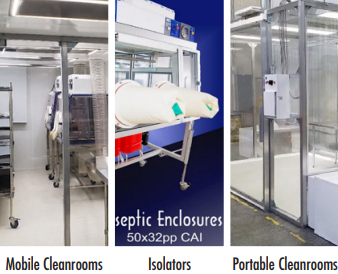
- Compounding aseptic isolators provide ISO Class 5 environments while physically separating the workspace from surrounding areas. These closed systems can simplify facility requirements and enable sterile compounding where building a full cleanroom would be impractical.
- Modular cleanroom systems can be installed within existing pharmacy footprints, reducing construction timelines and costs compared to traditional buildouts.
- Mobile cleanroom units provide complete, self-contained environments—useful for maintaining operations during renovations, testing demand before permanent construction, or adding temporary capacity.
3. Invest in Training
Your team’s competency determines both compliance and efficiency. Training must cover:
- Aseptic technique and sterile compounding procedures
- USP 797 and USP 800 compliance requirements
- Contamination control and environmental monitoring
- Media fill testing and quality assurance protocols
- Hazardous drug handling (if offering oncology or other HD preparations)
USP 797 requires personnel to demonstrate competency through gloved fingertip sampling, media fill testing, and observation of hand hygiene and garbing—initially and then every six months for Category 1 and 2 work.
4. Develop Provider Relationships
The best sterile compounding operation won’t generate revenue without customers. Focus your outreach on providers who need compounding services: hospitals, oncology practices, ophthalmologists, pain management clinics, fertility centers, and home infusion companies. Physician education—showing how custom formulations solve clinical problems that commercial products cannot—builds referral relationships more effectively than generic marketing.
What to Expect: Realistic Growth Timeline
Pharmacies that successfully implement sterile compounding typically see meaningful revenue impact within 18-24 months. The initial investment period involves facility buildout, equipment installation, staff training, and regulatory approvals. Provider relationships take time to develop—hospitals and clinics need to validate your capabilities before committing to ongoing orders.
Once established, sterile compounding creates diversified revenue streams that reduce dependence on volatile PBM contracts. The recurring nature of provider relationships—monthly orders from the same hospitals and clinics—provides predictability that traditional retail dispensing lacks.
Partner With Compounding Equipment Experts
Aseptic Enclosures has supported hundreds of pharmacy compliance projects, helping owners add or expand sterile compounding capabilities while meeting USP 797 and USP 800 requirements. We understand that successful implementation requires more than equipment—it demands facility planning, regulatory expertise, and operational support.
Our solutions include:
Equipment: Compounding aseptic isolators, negative pressure isolators for hazardous drugs, mobile cleanrooms, modular compounding centers, HEPA filtration systems, environmental monitoring systems, and particle counters.
Services: Pharmacy planning and design, compliance audits, detailed facility design, and cleanroom training.
Flexible options: Rental equipment for temporary needs or pilot programs, allowing you to test sterile compounding services before committing to permanent infrastructure.
Whether you’re launching your first sterile compounding program or expanding existing capabilities, we can help you plan a solution that aligns with your growth goals and compliance requirements.

It’s clear that adding sterile compounding to a pharmacy can not only improve patient care with customized medications but also significantly boost profitability. This is a smart strategy for pharmacies looking to offer more personalized services while growing their business.
Thanks for the comment. Sorry for the late reply.