Executive Summary
Choosing the right cleanroom isn’t just a construction decision; it’s about keeping your patients safe and your pharmacy running smoothly.
A built-in cleanroom is a strong, permanent solution designed for long-term, high-volume operations. But it takes time, higher investment, and can disrupt daily work during construction.
A mobile cleanroom, on the other hand, is quick, flexible, and ready to use. It helps you stay compliant, avoid downtime, and adapt as your needs change.
Both options meet USP <797> and USP <800> standards—the best choice simply depends on your timeline, budget, and plans.
In many cases, pharmacies benefit from using both—combining stability with flexibility
Mobile Cleanroom vs. Built-In Cleanroom
If you or someone is planning to start a new sterile compounding service, upgrade your current cleanroom to meet USP <797> and USP <800> requirements, or want to find a quick way to start the service, this question always comes to mind.
“Is a permanent cleanroom, or is a mobile cleanroom a better option for our pharmacy?”
It is a major decision for a pharmacy director, hospital administrator, or compounding facility manager to make. Choose the right option, and you will have a safe, efficient, and cost-effective setup that can support patient care for a very long time, and if you choose the wrong option, then you may face some big issues that can lead to higher costs, delays which can interrupt the ongoing operations, or if regulations change, then you may need to rebuild.
This blog can help you choose the right option for your pharmacy, hospital, or compound facility. The main differences between mobile and built-in cleanrooms are how each option meets USP 797 and USP 800 standards, the cost, the timeline, the advantages and disadvantages of both, which can help you choose the best option for your needs.
At Aseptic Enclosures, we have worked with many hospitals, independent pharmacies, oncology centers, and outsourcing facilities across the United States to design, build, and deploy sterile compounding environments. We build mobile cleanrooms in St. Louis, Missouri, and have experience with such situations. This blog is based on our hands-on experience.
Understanding Why Your Cleanroom Decision is so important
Before comparing the options, it’s important to understand why these choices really matter.
The 2012 fungal meningitis outbreak, which was linked to contaminated sterile medications from a compounding pharmacy, caused the deaths of 64 people, and nearly 800 people got sick. After this tragedy, rules for sterile compounding became stricter. This tragedy accelerated the enforcement of USP <797> nationwide and led to the Drug Quality and Security Act of 2013, which expanded FDA oversight of compounding facilities.
Nowadays, organizations like state pharmacy boards, the FDA, the Joint Commission, and CMS thoroughly inspect sterile compounding facilities. Your cleanroom is not just a place; it plays a vital role in patients’ safety and meeting regulatory requirements. These organizations inspect and carefully evaluate everything by the time they appear in your sterile compounding facility.
That’s why deciding between a mobile cleanroom and a fixed one is not just about construction or space planning. It affects how you can follow regulations, control the cost, keep your work running smoothly, and, most importantly, keep patients safe.
What Is a Built-In (Stick-Built) Cleanroom?
A built-in cleanroom, also known as a stick-built or permanent cleanroom, is a sterile compounding area constructed as a permanent fixture of a pharmacy. It is constructed using traditional building methods and becomes a permanent structural element of the facility.
How Built-In Cleanrooms Are Constructed
Traditional stick-built cleanrooms are constructed as permanent, non-porous, and airtight buildings to control airborne particles, temperature, and humidity. Unlike modular units, these are built in place, usually as a box-in-a-box inside an existing building, to isolate critical processes from standard manufacturing environments. steel frames and covered in gypsum drywall, then coated with a grade-level epoxy paint approved for pharmaceutical environments. The ceiling is typically a hard gypsum ceiling or a ceiling grid system. Flooring uses seamlessly coved vinyl to eliminate cracks where contaminants could accumulate.
USP 797 and USP 800 Requirements for Built-In Cleanrooms
Whether the cleanroom is constructed using traditional building methods or made with modular panels, all built-in pharmacy cleanrooms are required to follow the same fundamental USP standards.
- An ISO Class 5 Primary Engineering Control (PEC) is the core controlled area of work in which sterile compounding activities take place.
- ISO Class 7 buffer room crucial for sterile compounding areas, especially where PECs are located.
- ISO Class 8 ante-room is an area between the buffer room and the general pharmacy area, serving as a controlled passageway between the two spaces.
- Under USP 797 requirement, non –hazardous compounding requires the buffer room to maintain a positive pressure of 0.020 inches water column in relation to the ante-room.
- Under USP 800, the buffer room designated for hazardous drug compounding is required to maintain negative pressure in relation to all adjoining spaces.
- All surfaces must be smooth, non-porous, and able to handle strong cleaning chemicals.
- HEPA filtration to make sure a minimum of 30 air changes per hour are maintained throughout ISO class 7 designated spaces.
- All cleanrooms and equipment must be tested and certified twice a year.
What Does a Built-In Cleanroom Typically Include?
A fully compliant built-in pharmacy cleanroom includes:
- Gowning room or anteroom: an area where staff can put on clean gowns, gloves, masks, and other protective gear before entering.
- Buffer room (ISO Class 7): the main area where all sterile compounding takes place.
- Hazardous drug buffer room (ISO Class 7, negative pressure): A negatively pressurized compounding space required when a facility prepares hazardous substances.
- Pass-through chambers: Sealed transfer ports that allow you to move materials and medications between clean and non-clean areas without cross-contamination.
- Differential pressure monitors: Continuous tracking of air pressure levels between rooms to ensure the required levels at all times.
What Is a Mobile Cleanroom?
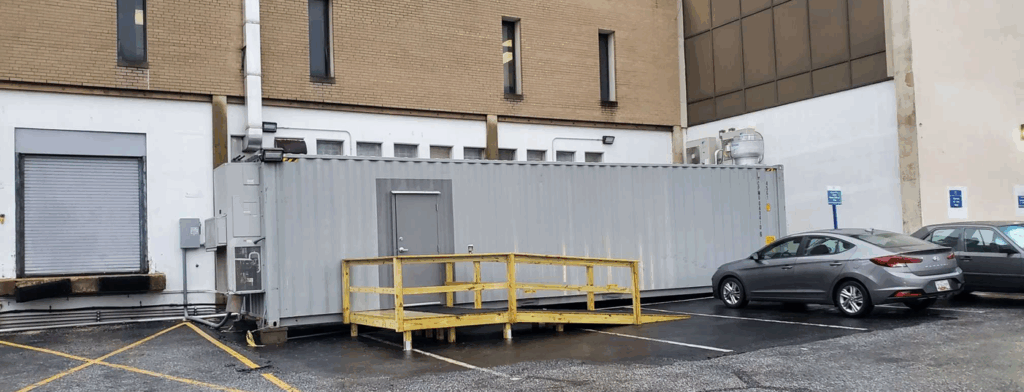
A mobile cleanroom is a ready-to-use sterile compounding space that is built inside a trailer, modular unit, or standalone structure. It is delivered fully assembled and can be used right away. No construction needed.
The word ‘mobile’ can be confusing. Some units can be delivered on wheels like a trailer, while others are on a flatbed truck and placed near your facility. They cannot move around regularly, but can be relocated if needed. They are fully built, set up, and pre-certified at a factory before they are delivered to your place.
How Mobile Cleanrooms Are Built
Mobile pharmacy cleanrooms are built to meet USP <797> and <USP 800> standards. It is equipped with the same high-quality materials found in any certified pharmacy cleanroom.
At Aseptic Enclosures, we build our mobile cleanrooms at our St. Louis facility and deliver and have them ready to use.
Typical Configuration of a Mobile Pharmacy Cleanroom
A mobile pharmacy cleanroom includes everything you can find in a traditional built-in cleanroom, which includes the following:
- Separate gowning room that meets ISO 8 air cleanliness standards.
- Clean, positively pressurized room that meets ISO class 7 standards, which is used for safely mixing non-hazardous sterile medications.
- Negatively pressurized room which meets ISO class 7 standards, which is used for safely handling and mixing hazardous drugs in compliance with USP <800> requirements.
- Sealed passage with HEPA air filters for safely transferring sterile materials between rooms.
- Built with a monitoring system that tracks room conditions, which sends alerts if anything is out of range, and saves reports automatically.
- Automatic doors lock with pressure indicators.
- Sink in the gowning room for proper hand and arm wash as per USP requirements.
- Separate areas are for unpacking and storing hazardous drugs.
Real-World Example: a large cancer center pharmacy at YALE NEW HAVEN HEALTH was under major renovation, so the hospital leaders chose a mobile cleanroom to keep chemotherapy preparation running without any interruptions. Which allow them to serve patients while the permanent pharmacy was completely renovated to meet the latest USP <797> and <800> standards. Connecticut Drug Control Division and the Department of Health inspected the mobile unit and gave it approval without any problems.
4. Mobile vs. Built-In: The Head-to-Head Comparison
| Factor | Mobile Cleanroom | Built-In (Stick-Built) Cleanroom |
| Deployment Time | 3–6 weeks | 6–18+ months |
| Construction Permits | Not required | Required in most states |
| Upfront Cost | Lower to moderate | Moderate to high |
| Long-Term Cost | Lease or own; relocatable | Fixed; renovation costs apply later |
| USP 797/800 Compliance | Yes — pre-certified | Yes — requires validation after build |
| Customization | Standard + custom options | Fully custom to your space |
| Relocation | Yes — movable | No — permanent structure |
| Disruption to Operations | Minimal — installed outside or on a dock | Significant — construction inside the facility |
| Scalability | Add units as needed | Requires renovation to expand |
| Best For | Renovations, urgent need, multi-site, temporary | Long-term permanent operations, large volume |
The Decision Framework: Which Option Is Right for You?
Use this practical decision table to guide your selection:
| Your Situation | Best Choice | Why |
| Undergoing a USP 797/800 renovation | Mobile Cleanroom | Keep compounding running during construction |
| Opening a brand-new pharmacy | Built-In or Mobile | Depends on timeline and budget |
| Need a cleanroom in 4–6 weeks | Mobile Cleanroom | Pre-certified, no permit delays |
| Long-term high-volume production | Built-In | Better for large-scale, permanent workflows |
| Leasing your pharmacy space | Mobile Cleanroom | No permanent modification to the leased building |
| Serving multiple hospital campuses | Mobile Cleanroom | Can be relocated between sites |
| 503B outsourcing facility | Built-In | FDA cGMP requires a permanent, validated facility |
| Budget is the primary concern | Mobile Cleanroom (rental) | Lowest upfront cost, no construction |
Key Questions to Ask Before You Decide
- How quickly do you want the clean room ready? If you need it within 60 days, a mobile cleanroom is a good option for you.
- A mobile cleanroom can help you avoid interruptions when any renovation or construction is happening.
- What is your total budget, including permits, design fees, and certification?
- How likely is it that your needs or location will change in the next 5 years? If things are uncertain, a mobile cleanroom gives you more flexibility.
What to Look for in Any Cleanroom Provider
Whether you choose a mobile cleanroom or a built-in one, the quality of the provider is just as important as the type of cleanroom. Here’s what you should look at:
USP Expertise
Your provider should have strong experience with USP <797> and <800> requirements, not just general cleanroom building experience. Pharmacy cleanrooms have very specific needs that general builders may not fully understand.
Pre-Certification for Mobile Units
Make sure the mobile cleanroom is certified before it arrives. The unit should come with proof of ISO classification, airflow test results, verified pressure relationships, and fully working monitoring systems. Don’t choose any mobile Cleanroom that needs certification after delivery
State Board of Pharmacy Experience
State pharmacy boards make cleanroom rules. And each state has its own USP standards. Your provider should know how to get cleanroom approval in your state.
Environmental Monitoring Integration
Modern pharmacy cleanrooms need constant environmental monitoring, tracking particles, pressure differences, temperature, humidity, and sometimes air microbes. Your cleanroom comes with or is able to connect to a system that monitors all this with real-time alerts, data logging, and reports ready for audits.
Full-Service Support
Top cleanroom providers offer more than just delivering equipment; they also help with pharmacy planning and design, staff training on aseptic techniques, and gowning.
How Aseptic Enclosures Can Help
Aseptic Enclosures, based in St. Louis, Missouri, has been a trusted partner for hospital pharmacies, health systems, oncology centers, and compounding facilities across the U.S for decades. They manufacture mobile cleanrooms, design and build permanent cleanroom installations, supply sterile compounding equipment and materials, offer rental services for their equipment, provide staff training, and deliver complete compliance support services that modern pharmacy cleanrooms require.
Our Mobile Cleanroom Solutions
Our mobile pharmacy cleanrooms are built in our St. Louis facility to meet USP <797> and USP <800> standards. Each cleanroom comes with:
- Pre ISO classification, ready for any inspection.
- A cloud-based monitoring system that tracks conditions in real time and sends alerts.
- A positive-pressure ISO 7 room for non-hazardous sterile compounding.
- Equipped with a negative-pressure room for handling hazardous drugs.
- Equipped with HEPA-filtered pass-through, interlock doors, and a gowning room with hand-washing facilities.
- Available for buy or rent for short or long term.
- Delivery within 3 to 6 weeks from order confirmation
Our Pharmacy Planning and Design Services
Our experts have managed hundreds of USP <797> and <USP 800> projects and can help assess your needs, timeline, budget, and compliance requirements, creating a plan that works for your patients, staff, and governmental inspection.
Our Compliance Audit Services
Before investing in a new cleanroom, get a professional pharmacy compliance audit. Our experts can find out gaps in your sterile compounding setup, give you recommendations, and create a compliance roadmap to prepare you for the next inspection.
Conclusion: The Right Cleanroom for Your Pharmacy
Mobile cleanrooms are fast, flexible, and cost-effective for most pharmacies, while permanent cleanroom suits stable, high-volume facilities. Many pharmacies and hospital prefferd both for extra flexibility.
Aseptic enclosures can help you with choosing, designing, and implementing the best cleanroom solution efficiently and within your budget.
Ready to evaluate your cleanroom options?
Contact Aseptic Enclosures today for consultation with our expert project team. We have managed hundreds of USP 797 and USP 800 compliance projects and can help you find the right solution for your pharmacy.